

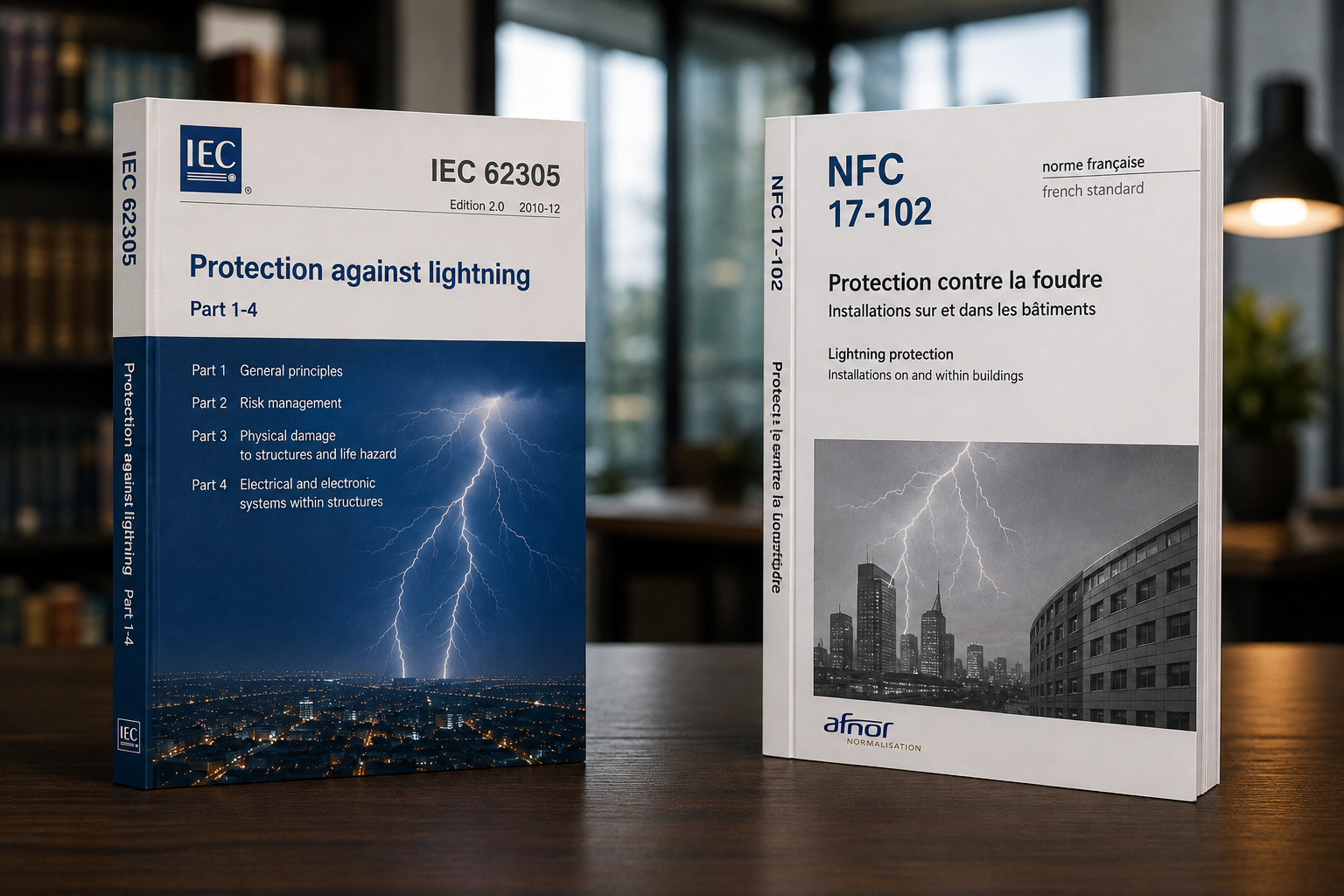
Early Streamer Emission is the most contested topic in our field. Clients ask for it because one mast can replace a mesh; reviewers challenge it because the mainstream standards do not recognise it.
What each system is
A conventional (Franklin/Faraday) system uses rods, mesh or catenary conductors positioned by the rolling sphere method, with multiple down conductors distributing the current. An ESE terminal contains a triggering device intended to initiate an upward leader earlier than a simple rod, and is credited under NF C 17-102 with a radius of protection derived from that advance time.
The standards position
- IEC 62305 makes no provision for ESE devices; a design citing IEC cannot justify ESE coverage from that standard.
- NFPA 780 has repeatedly declined to include ESE in the body of the standard.
- NF C 17-102 (French standard, widely used internationally) does define the design method.
- Some regional authorities and private clients accept NF C 17-102; many EPC specifications explicitly forbid it.
Where each fits
For open areas — storage yards, sports facilities, car parks, temporary sites — a single mast under NF C 17-102 is practical and often the only workable option. For process plants, substations, data centers and any facility with a specification citing IEC or NFPA, conventional protection is what we recommend and what will pass review. Whichever route is chosen, the earthing and SPD design carries the same weight: an ESE terminal on a poor earth protects nothing.