

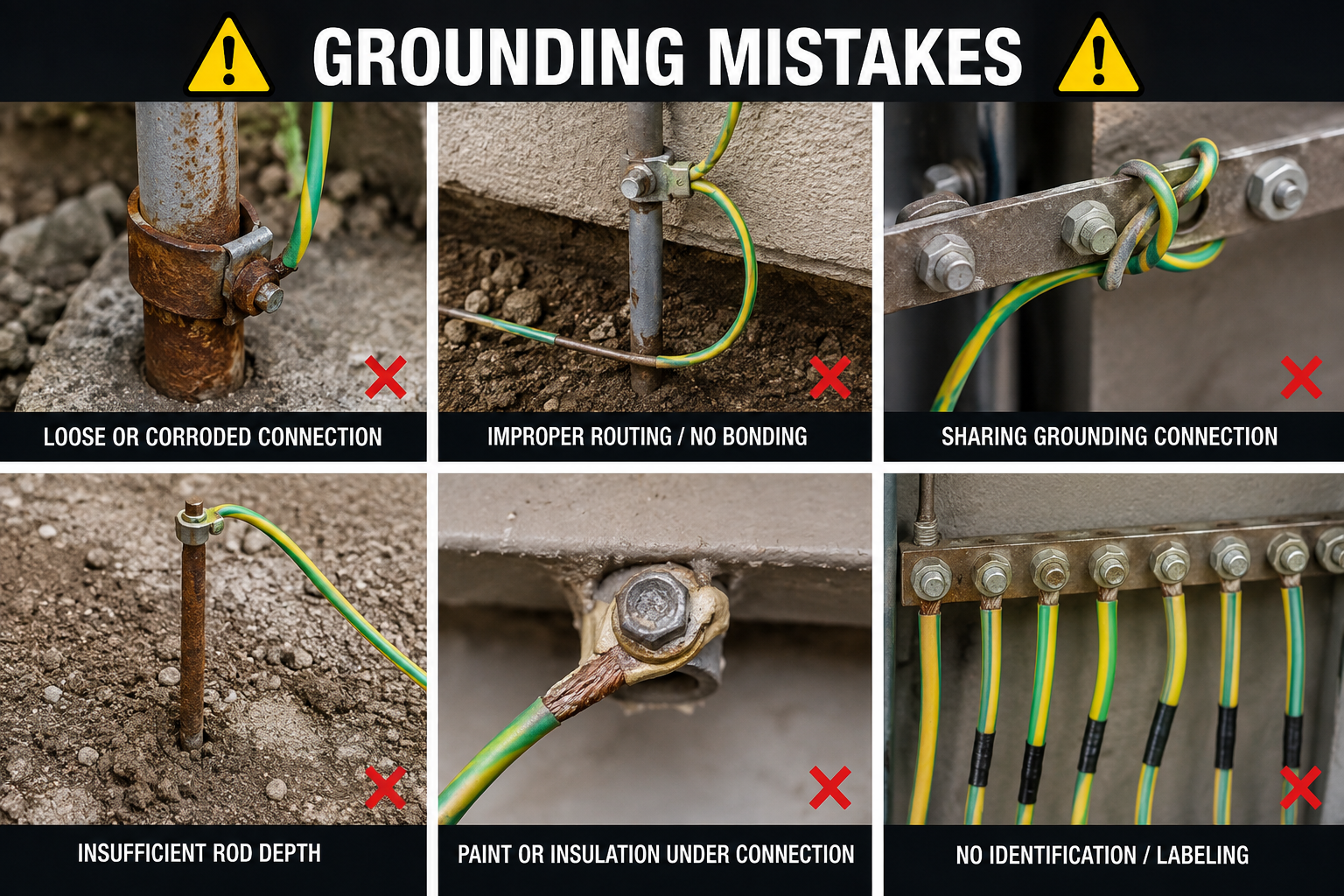
After nearly two decades of testing and remediation across the region, the same defects appear again and again. None of them are exotic.
The recurring nine
- Bolted or clamped joints buried below grade instead of exothermic welds — corrosion raises resistance within a few years.
- Separate ‘clean’ and ‘dirty’ earths, unbonded, creating dangerous potential differences.
- Rods driven into backfill or trench spoil rather than undisturbed soil.
- Electrodes spaced closer than their driven length, so the arrays overlap and add little.
- Undersized conductors chosen from a table without checking fault current and duration.
- Paint left under bonding connections at steel columns and enclosure studs.
- Missing or inaccessible test links, making the system impossible to verify later.
- Earth pits paved over, buried by landscaping or lost after civil works.
- Commissioning results recorded without ambient conditions, so they cannot be compared to future tests.
Catching them
Three inspection points prevent nearly all of it: witness the welds before backfill, witness the bonding before cladding or paint, and run a full fall-of-potential and continuity set at commissioning with conditions logged. A hold point in the ITP costs nothing compared to excavating a compound.