

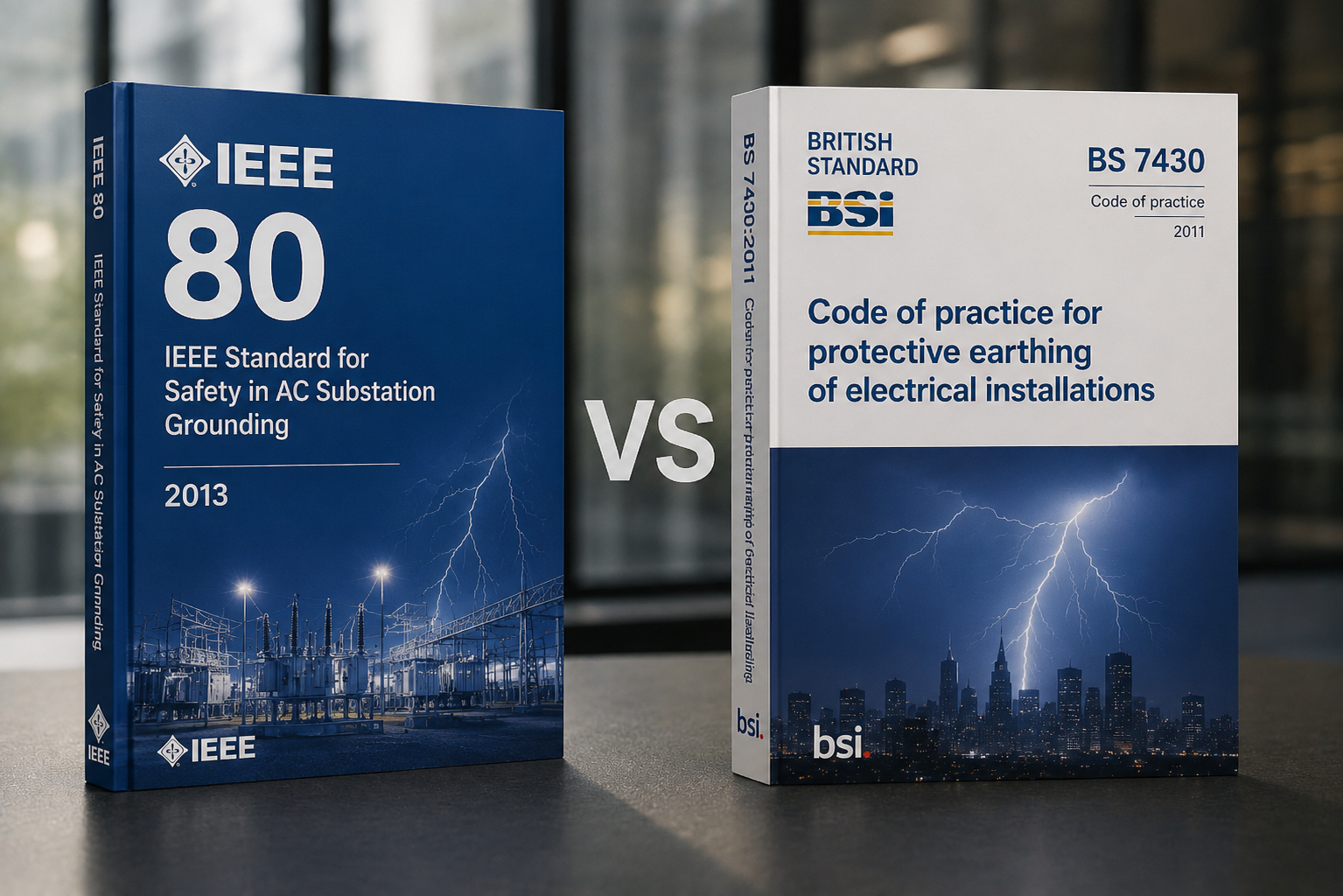
Specifications in the GCC often name both standards in the same paragraph, which leaves designers unsure which governs. They answer different questions.
Different purposes
IEEE Std 80 is a guide for safety in AC substation grounding. Its core method calculates the maximum grid current, the resulting ground potential rise, and the actual step and touch voltages, then compares them with tolerable limits derived from body current and surface layer resistivity. BS 7430 is a code of practice for protective earthing of electrical installations — broader in scope, more prescriptive in detail, less analytical.
Where they diverge
- Acceptance criteria: IEEE 80 accepts a high grid resistance if step/touch voltages are safe; BS 7430 practice tends toward fixed resistance values.
- Surface layer: IEEE 80 explicitly credits crushed rock in the safety calculation; BS 7430 does not model it the same way.
- Conductor sizing: IEEE 80 sizes for fault current, duration and material decrement factor; BS 7430 gives tabulated minimums.
- Scope: IEEE 80 stops at the substation fence; BS 7430 covers building installations, lightning interface and equipment bonding.
Practical application
On a typical industrial or utility project we run the IEEE 80 calculation for the HV yard and any area where a ground fault produces significant GPR, and apply BS 7430 (with IEC 60364 clauses) to the LV distribution, buildings and equipment bonding. Both sets of output go into one earthing report so the reviewer can see which criterion governed each area.