

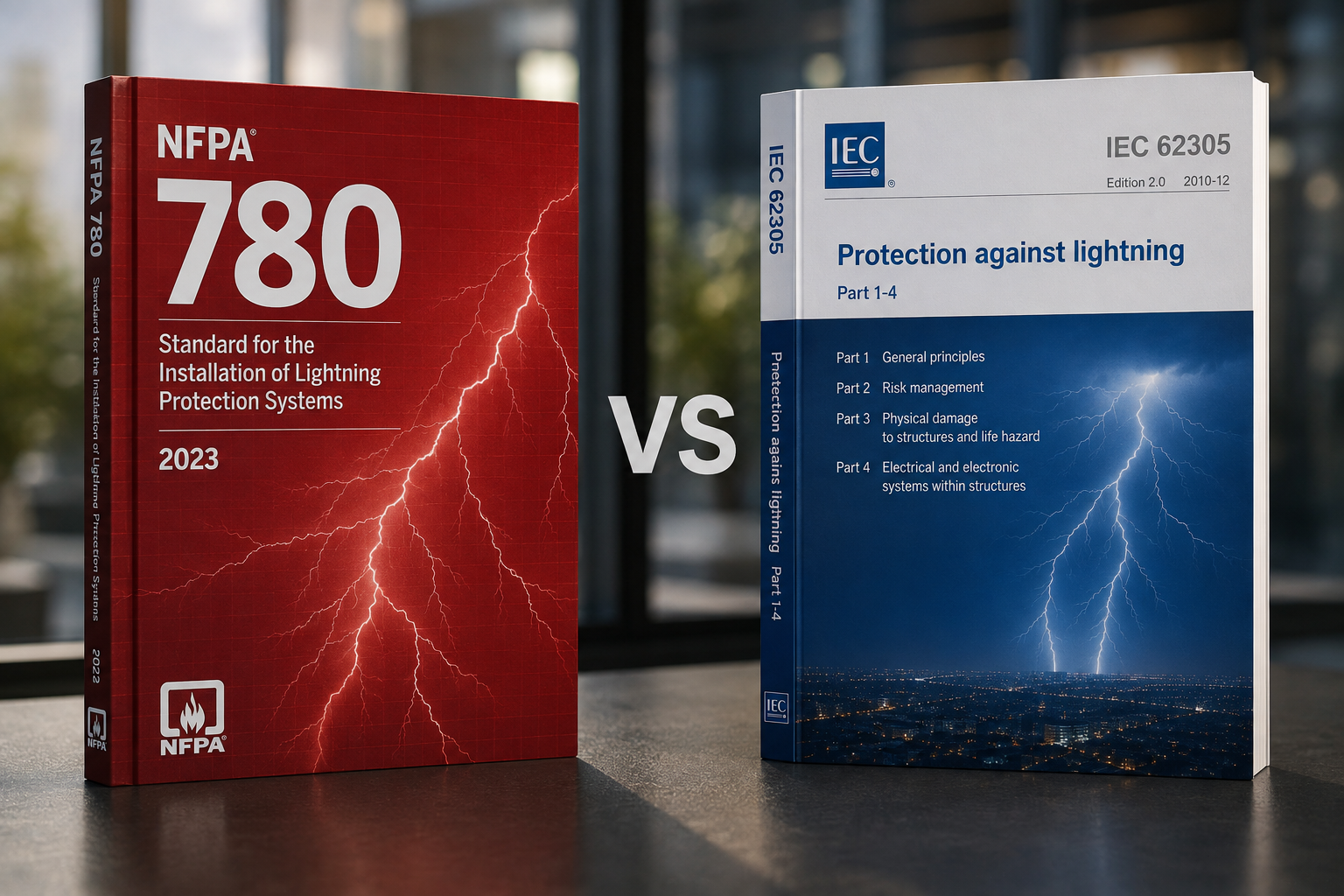
Both standards produce a safe structure. They get there differently, and mixing clauses from each creates a design that satisfies neither reviewer.
Philosophy
IEC 62305 asks how much protection this structure needs, computing risk components against tolerable limits and outputting a protection level. NFPA 780 asks what a compliant installation looks like, and specifies it: strike termination spacing, Class I and Class II materials by structure height, down conductor intervals and grounding requirements.
Design consequences
- Down conductor spacing: IEC varies by LPL (10–25 m); NFPA 780 uses a broadly uniform average interval.
- Air terminals: NFPA prescribes placement at roof edges and within set distances of corners; IEC allows rod, mesh or catenary methods proven by rolling sphere.
- Risk: IEC 62305-2 is a full quantitative annex; NFPA 780 offers a simplified risk assessment in Annex L.
- Surge protection: IEC 62305-4 integrates LEMP protection zones; NFPA 780 addresses SPDs more briefly.
Choosing for GCC projects
Follow the client specification. Aramco and most European-influenced EPCs work to IEC 62305; American EPCs and oil & gas clients with US heritage call NFPA 780. Where the spec names both, we design to the more onerous requirement clause by clause and document the basis in the design report.